More than 475,000 Wisconsin residents have diabetes, mostly type 2. This type of diabetes is associated with diet and obesity and is helped through healthy dietary intake. Yet, more innovations in dietary interventions are needed. By leveraging expertise in metabolism and plant genetics, this novel project proposes to develop a source of plant-based foods that will reduce dietary intake of certain nutrients associated with obesity. The findings will inform future studies with the ultimate goal of improved treatment of diabetes and obesity.
This project is led by Dudley Lamming, PhD, associate professor, Department and of Medicine and co-principal Investigator: Jacob Brunkard, PhD, assistant professor, Department of Genetics, UW–Madison College of Agricultural and Life Sciences. Collaborators include: Dawn Davis, MD, PhD, professor, Department of Medicine; Daniela Drummond-Barbosa, PhD, professor, Department of Genetics, UW–Madison College of Agricultural and Life Sciences; Shawn Kaeppler, PhD, professor, Department of Agronomy, UW–Madison College of Agricultural and Life Sciences; Hiroshi Maeda, PhD, professor, Department of Botany, UW–Madison College of Letters and Sciences; Judith Simcox, PhD, assistant professor, Department of Biochemistry, UW–Madison College of Agricultural and Life Sciences; Gregory Barrett-Wilt, PhD, Director of Mass Spectrometry, UW–Madison Biotechnology Center.
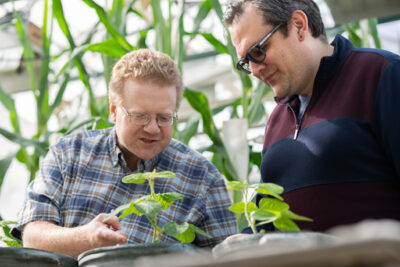
Dudley Lamming (left) and Jacob Brunkard
The Challenge
More than 475,000 Wisconsin residents have diabetes, at an annual health care cost of over $6 billion. An additional 1.4 million Wisconsin residents over the age of 20 are estimated to have pre-diabetes, making diabetes care one of the most urgent health care problems facing Wisconsin. Diabetes is an especially acute problem for underserved communities as over 40 percent of Native American and 20 percent of African American adults have the chronic condition. The vast majority of diabetes cases in the United States and Wisconsin are type 2 diabetes associated with diet and obesity, suggesting the possible benefits of dietary interventions.
Project Goals
To address the challenge, the specific aims of this project are:
To define the precise levels of IIe and His that optimize metabolic health in mice preconditioned with a high fat, diabetogenic diet;
To engineer soy plants to reduce levels of dietary IIe and His; and
To test the ability of the edited soy protein to promote metabolic health in diet-induced obsese mice.
Progress Update
As of year 2, this project made progress toward understanding how targeted dietary amino acid restriction can improve metabolic health. Experimental studies in mouse models demonstrated that reducing dietary isoleucine produced measurable, dose-dependent improvements in body weight, fat mass and glucose tolerance. Notably, a 55 percent reduction in isoleucine was identified as sufficient to achieve meaningful metabolic benefits without adverse effects on lean mass in certain groups, helping to refine optimal intervention levels.
Further experiments showed that isoleucine restriction not only improved glycemic control in diet-induced obese mice but also led to rapid weight normalization, reinforcing its potential as a therapeutic dietary strategy. In addition, the project uncovered a novel effect of isoleucine restriction on cholesterol metabolism, with findings showing significant reductions in total and LDL cholesterol. Mechanistic investigations suggest this effect may be mediated through increased hepatic LDL receptor levels and reduced PCSK9 expression, pointing to a potential alternative or complementary approach to traditional cholesterol-lowering therapies.
In parallel, the project advanced its translational aims by continuing development of engineered plant-based proteins (“SuperSoy” and “SuperCorn”) designed to contain reduced levels of key amino acids. Progress included ongoing testing of RNAi-based approaches and the initiation of more stable CRISPR/Cas9 gene editing strategies to modify seed storage proteins in soy and maize. These efforts position the project to produce scalable, food-based interventions that could support population-level improvements in metabolic health.